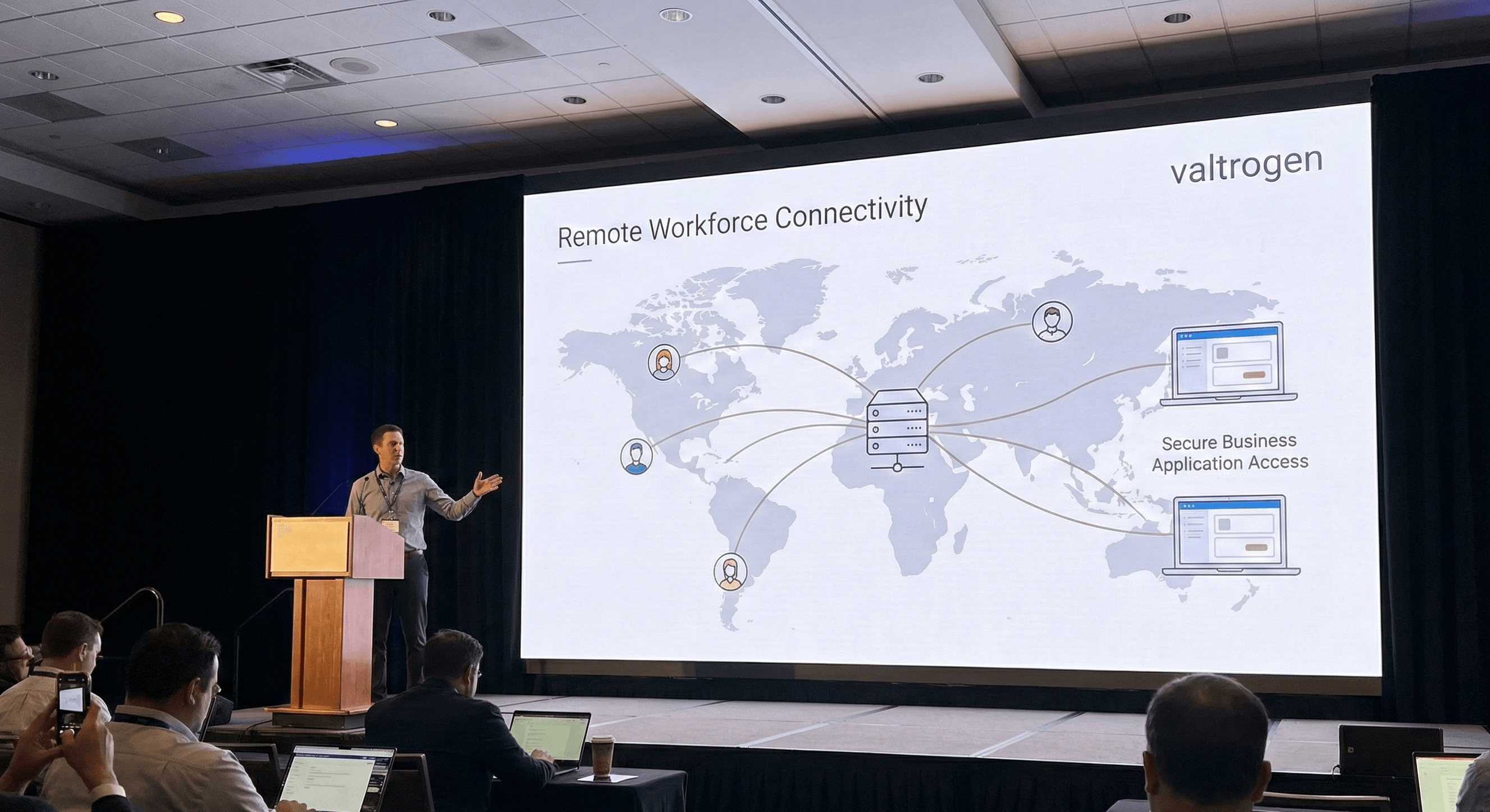
1. Opening (event summary)
We participated in a North America industry technical conference and exchange forum. Valtrogen’s engineering team was invited to deliver a live walkthrough and on-stage explanation of an enterprise remote access and business-system connectivity approach.
The session focused on a concrete question: how remote employees can reliably connect to enterprise network resources and complete business access tasks with consistent experience across regions—presented as an event recap, without marketing slogans.
2. Background
The conference aimed to foster technical exchange around enterprise communications, network architecture, cross-region connectivity, and collaboration practices. Attendees included industry engineers, technical teams, enterprise customers, and ecosystem partners.
Valtrogen was invited to contribute a practical talk on remote work connectivity and business application access, including a live demonstration on an LED screen, stage Q&A, and follow-up solution discussions.
3. Key directions discussed on stage
We structured the talk around the recurring challenges enterprises face when employees work remotely across regions:
- Consistency across regions: similar access behavior and predictable paths when users are distributed globally
- Connection stability: minimizing disruptions and reducing time-to-recover when conditions change
- Business system access experience: keeping access responsive for critical internal applications
- Remote collaboration and internal app onboarding: enabling teams to connect to the tools they need with clear operational ownership
Instead of focusing on a single tool, we discussed an approach that standardizes how employees access enterprise network resources, improves the reliability of business-system access, and supports compliant cross-border collaboration—framed in terms of operational requirements and validation steps.
We also referenced several typical scenarios discussed with attendees:
- Remote offices accessing internal systems with defined success metrics
- Cross-region engineering collaboration where build systems and internal services must remain reachable
- Business applications accessed from multiple regions with consistent behavior
- Globally distributed employees requiring stable access paths and clear support escalation
4. Live Q&A and technical exchange
Following the demonstration, engineers held a Q&A session and continued discussion with participants about connectivity architecture and operational considerations. Attendees shared real requirements and constraints from their environments; our team recorded scenarios and discussed architecture patterns and tradeoffs.
5. Feedback from engineers and enterprise teams
In post-session conversations, several themes were repeated by participants (summarized as third‑party perspectives):
- A preference for more stable connectivity under changing conditions
- More consistent business access experience across regions
- More reliable cross-region collaboration for distributed teams
- Clearer integration paths and operational ownership within enterprise environments
6. Next steps
We will consolidate the feedback into actionable inputs for the next iteration of our architecture and operational improvements. We also plan to continue participating in North America and global technical exchange events, and keep collaborating with engineers, customers, and ecosystem partners to refine remote work connectivity and business access capabilities.
7. Closing
We appreciate the conference organizers and attendees for the discussion and feedback. We will continue to operate with an engineering-first, open and collaborative culture—sharing field notes, technical learnings, and practical next steps through future updates.